Runfeng Li

Hi, I am a first-year Ph.D. student in Electrical and Computer Engineering at Rice University.

Before this, I did my Master's in Computer Science at Brown University, where I worked with Prof. James Tompkin, and collaborated with Prof. Matthew O'Toole and Dr. Christian Richardt. I earned my Bachelor's in Mathematics and Computer Science from University of Illinois Urbana-Champaign.

Email: runfeng_li [at] rice [dot] edu

GitHub  /  Google Scholar  /  CV  /  LinkedIn

profile photo

Research

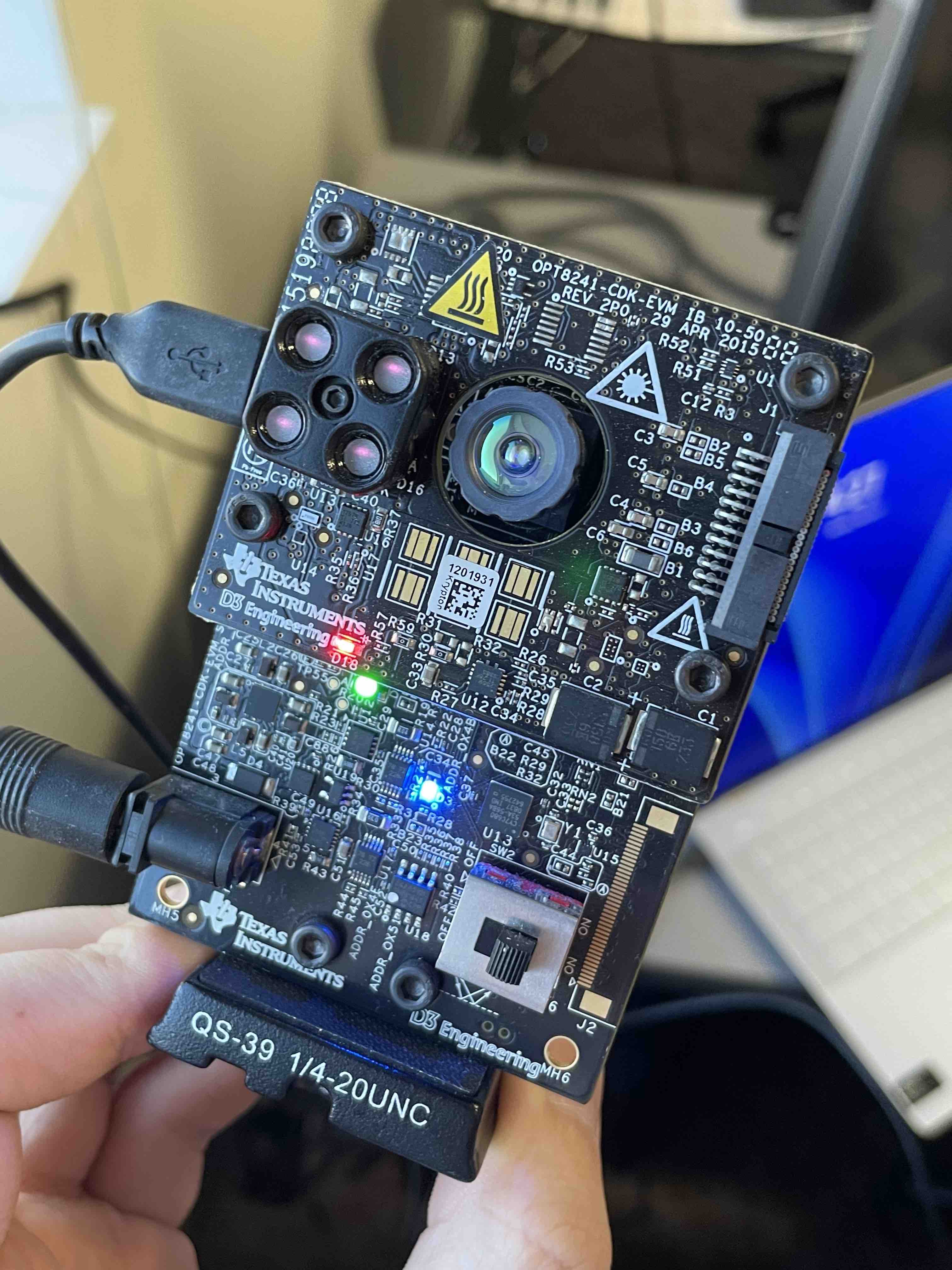
I have spent much of the last few years on things like this. It uses a LiDAR-like camera to reconstruct 3D scenes, though, hilariously, I have only physically touched the camera once in my life.

Currently, I am broadly interested in computational photography and imaging, computer vision, and machine learning.

Time of the Flight of the Gaussians: Optimizing Depth Indirectly in Dynamic Radiance Fields
Runfeng Li, Mikhail Okunev, Zixuan Guo, Anh Ha Duong, Christian Richardt, Matthew O'Toole, James Tompkin
CVPR, 2025 (Oral)
project page / paper / code / supplemental video

We show that radiance field reconstruction from single-frequency continuous-wave raw time-of-flight images is fundamentally ill-posed. However, we find optimization biases in the 3D-Gaussian-parameterized radiance fields that reasonably regularize the geometry. We then exploit this finding to reconstruct dynamic scenes like fast-swinging baseball bats with quality comparable to or better than prior neural-field-based methods while retaining the efficiency of Gaussians.

Monocular Dynamic Gaussian Splatting: Fast, Brittle, and Scene Complexity Rules
Yiqing Liang, Mikhail Okunev, Mikaela Angelina Uy, Runfeng Li, Leonidas J. Guibas, James Tompkin, Adam Harley
TMLR, 2025
project page / paper / code

We benchmark dynamic Gaussian splatting methods for monocular view synthesis, combining existing datasets and a new synthetic dataset to provide standardized comparisons and identify key factors affecting efficiency and quality.

Other Past Interests

Material Elasticity Reconstruction

We estimate Young's modulus by backpropagating video-reconstruction gradients through our Taichi implementation of PhysGaussian.


Reference: Jon Barron's Template.